
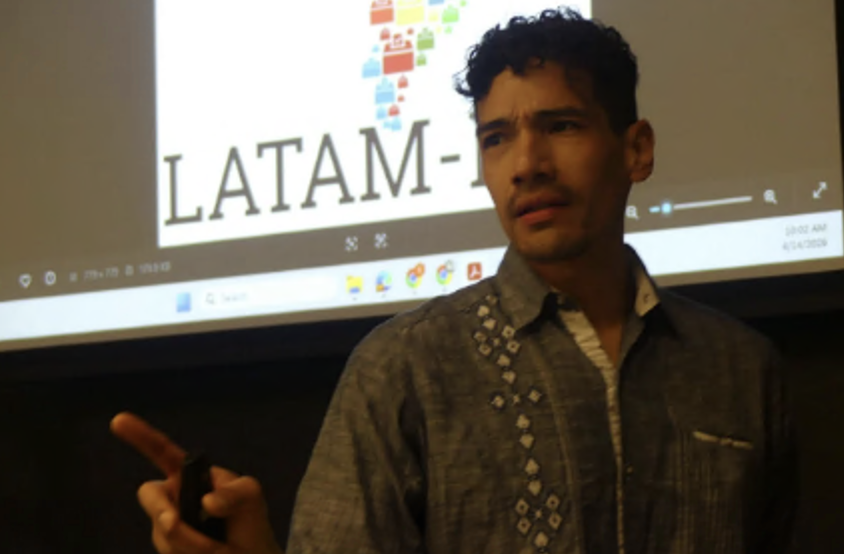
Edgar Franco-Vivanco Wins REPAL’s Best Paper Award
July 29, 2026
University of Michigan researcher recognized for groundbreaking study on colonial institutions and Indigenous identity in Mexico
Edgar Franco-Vivanco, an assistant professor of political science at the University of Michigan and affiliate of the Center for Political Studies, has received the Best Paper award from the Red para el Estudio de la Economía Política de América Latina (REPAL) for his paper “Jurisdictional Havens: The Geography of Indigenous Identity in Mexico,” co-authored with Jenny Guardado of Georgetown University. REPAL announced its 2026 award recipients after hosting May’s 12th annual conference in Mexico City.
REPAL is one of the most important scholarly networks for Latin American research, bringing together researchers globally to promote empirically grounded, context-sensitive work on the political economy of the region.
About the Paper
“Jurisdictional Havens” offers a new explanation for the geographic persistence of Indigenous identity in Mexico.
The authors argue that during the colonial period (1520–1820), certain areas fell under overlapping civil and religious jurisdictions, creating competition among rulers. These “jurisdictional havens” gave colonial subjects—particularly Indigenous communities—unique opportunities to leverage competing authorities and secure prerogatives unavailable to other populations.
Using an 18th-century administrative map and a grid-cell research design, Franco-Vivanco and Guardado demonstrate that areas with overlapping ecclesiastical and civil jurisdictions have retained distinctly higher rates of Indigenous language use, self-identification, Indigenous family names, and communal land tenure. The authors employ several strategies to rule out the possibility that other factors explain their findings, and they draw on colonial-era judicial and administrative records to document the competition that characterized these “havens.” The authors also demonstrate that subnational borders were more likely to be drawn along lines that made enforcement easier for the state and consolidated administrative control, eliminating jurisdictional overlaps that had benefited Indigenous communities.
The findings illuminate how spatial proximity to competing authorities can enhance local autonomy and shape the long-term persistence of group identities.
A preprint version of the paper can be found here.
About the Authors
Edgar Franco-Vivanco conducts research exploring how colonial-era institutions and contemporary criminal violence shape economic underperformance in Latin America. He is founder and director of the Latin American Elections Hub, which organizes expert panels around the region’s most significant elections, probing their national and global relevance and their implications for democracy. Franco-Vivanco’s book project, Contesting the Empire: The Politics of Indigenous Resistance Under Colonialism, examines how Indigenous communities survived colonization by using strategies ranging from violent collective action to active collaboration, and from voluntary isolation to cultural assimilation. He is a previous recipient of the Mary Parker Follett Award for the best article in politics and history (2022), and the Heinz I. Eulau Award for the best article published in APSR (2021).
Jenny Guardado is an associate professor at the Center for Latin American Studies in the School of Foreign Service at Georgetown University. Her research examines political and economic mechanisms affecting armed conflict, corruption, and economic development. She is a previous recipient of the Pi Sigma Alpha Award for best paper presented at MPSA (2013) and the Oliver A. Williamson Prize for best paper at the International Society for New Institutional Economics Conference (2014).