
The Latin American Elections Hub: A New Window on Democracy at the University of Michigan
April 23, 2026
Bridging Continents Through Electoral Analysis
At a moment when democratic institutions face mounting pressure across the globe, the University of Michigan has become home to a new initiative designed to sharpen Americans’ understanding of politics in Latin America. The Latin American Elections Hub (LATAM-EH), founded by Edgar Franco-Vivanco, assistant professor of Political Science, organizes expert panels around the region’s most significant elections, probing their national and global relevance and their implications for democracy.
The hub will build connections across disciplines, scholars, students, and centers across the university. Insights from each panel can provide data-driven, model-oriented analysis to journalists and policymakers in the U.S., while offering students enrolled in Politics and Society in Latin America (POLSCI 347) opportunities to examine candidates, their profiles and policies, and engage directly with regional experts.
“The idea is to bring together experts from different disciplines to discuss elections that have really high stakes,” said Franco-Vivanco, whose previous panels at the University of Michigan have spotlighted the Brazilian elections of 2022, the Mexican elections of 2024, and Ecuador’s general elections last year. In alignment with the University of Michigan’s leadership in addressing democracy, civic, and global engagement, the formal establishment of the LATAM-EH in 2026 will provide ongoing opportunities to invigorate civic and global awareness and engagement.
This year’s events have included a discussion of Peru’s elections on March 26 and most recently, a deep dive into Colombia’s upcoming presidential contest.
Colombia at the Crossroads: A Panel Discussion
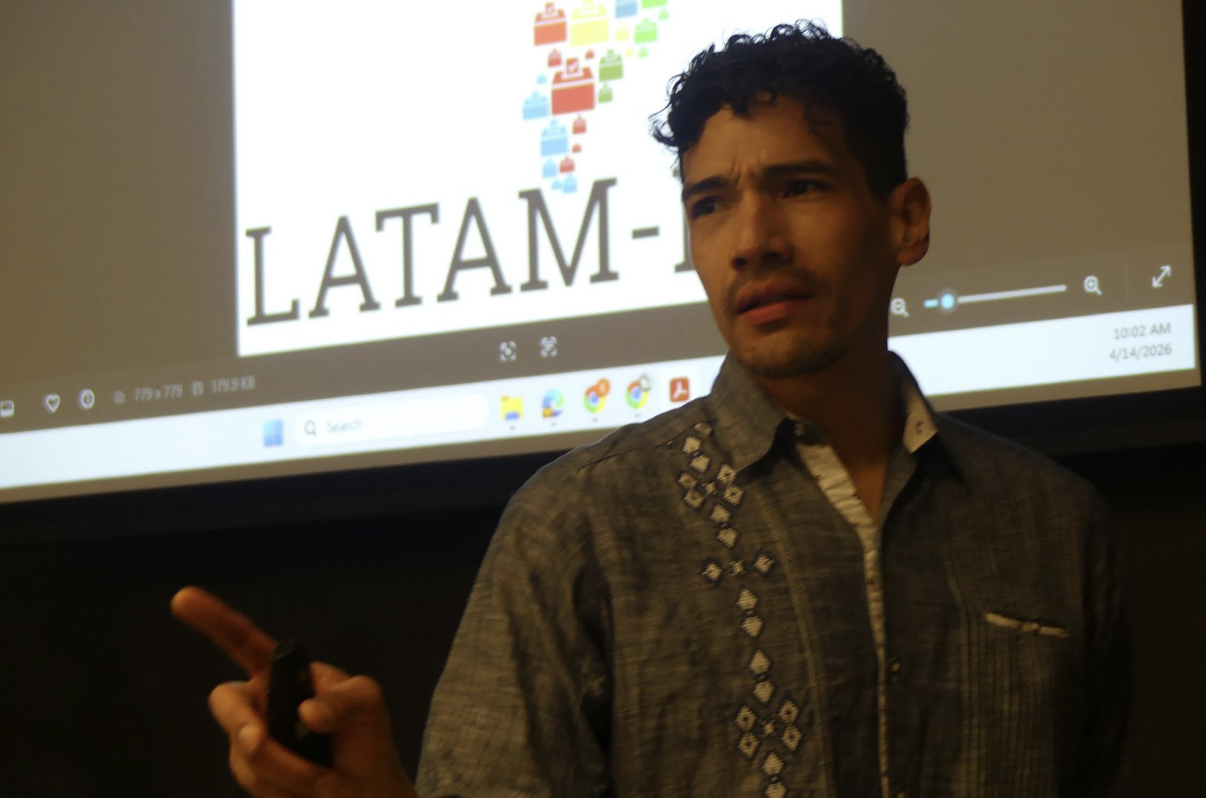
On April 14, LATAM-EH convened a panel on the 2026 Colombian elections, bringing together three scholars whose complementary expertise painted a multidimensional picture of a country at a political crossroads. The speakers—Juan Delgado, Leydy Diossa-Jiménez, and Camilo Nieto-Matiz—addressed the shifting ideological landscape, the surprising role of the diaspora vote, and the persistent shadow of violence over the electoral process.
A Fractured Right and a Shifting Electorate
Juan Delgado (assistant professor of sociology at U of M), whose research focuses on race, ethnicity, and social inequality in Latin America, opened the panel by framing Colombia’s election within a global moment of right-wing populism. He argued that the central dynamic of the race is the growing gap between what voters want and what political parties are offering. For decades, Colombian politics revolved around the armed conflict—a cleavage that organized parties, voters, and policy. The 2016 peace agreement process between the government and the FARC guerrilla fundamentally changed that calculus. As conflict receded from voters’ minds, issues like health care, education, and corruption rose to the top. Yet Colombia’s parties, Delgado argued, have largely failed to follow voters into this new terrain– creating an opening for populist challengers.
Polling data shows Iván Cepeda, the left-wing candidate and standard-bearer of the termed-out incumbent President Gustavo Petro’s coalition, in the lead. The right is currently split between Abelardo De La Espriella, a populist figure Delgado likened loosely to a “Colombian Trump,” and Paloma Valencia, a more establishment-oriented conservative. Centrist candidate Sergio Fajardo trails in the polls. But while Cepeda now leads in the rankings, the result of the presidential election to be held May 31 remains an open question.
The Diaspora as ‘Canary in the Coal Mine’
Leydy Diossa-Jiménez, a postdoctoral fellow at the University of Michigan’s Center for Emerging Democracies and a specialist in migration and political violence, argued that the Colombian diaspora vote may be a predictive signal for election outcomes. Colombia was one of the first countries in the world to extend presidential voting rights to its emigrants, beginning in 1991. The diaspora electoral roll has expanded eightfold since 2002, reaching over 1.2 million registered voters—though this still represents only about one in four of the estimated 5 million Colombians living abroad.
Drawing on data she has assembled since 2017—presented publicly for the first time at this event—Diossa-Jiménez demonstrated that the diaspora vote consistently runs about 15 percentage points to the right of the national result. The pattern, she said, is driven by the demographic composition of the diaspora: the large Colombian community in the United States, anchored in Florida and Los Angeles, skews conservative, and is heavily mobilized by the political machinery of the religious-right, she said, while smaller communities in Argentina and Europe lean left, shaped by the sociology of political exile. Diossa-Jiménez’s core thesis: Unless Cepeda clears 50 percent plus one in the first voting round on May 31, the diaspora pattern predicts the right will consolidate, and he will not win the runoff.
Violence, Security, and the Electoral Landscape
Camilo Nieto-Matiz, an assistant professor at the University of Texas at San Antonio, discussed the salience of political violence in shaping the electoral process in Colombia, noting that security has reemerged as a top concern among voters. More than 200 victims of political violence have been recorded since the campaign began in March 2025. Today’s armed groups are decentralized and locally focused, typically targeting local officials like council members and mayors who control municipal budgets. The regions experiencing the worst violence are those that tend to support the left, but voters there may attribute deteriorating security not to Petro’s contested “Paz Total” (Total Peace) policy, but instead to deeper historical abandonment by the state, Nieto-Matiz argued. Whoever wins the election, he said, will have to deal with a very complex landscape regarding budgets, armed organizations, and the bureaucratized military.
What’s at Stake
Colombia’s presidential election on May 31, 2026, will be the first test of whether the left can hold power through a democratic transition—or whether a divided right can consolidate in a runoff.
“This is the first time in many years in Colombia where we have unified support for a left-wing candidate and a split vote on the right,” said Delgado.
The first round will determine whether Iván Cepeda can achieve an outright majority or whether the contest proceeds to a second round on June 21, where historical patterns and diaspora dynamics may favor the right. The next president will be inaugurated on August 7. The outcome will have implications not only for Colombian democracy and the future of the peace process, but also for the broader trajectory of left-wing governance and right-wing populism across Latin America. It will also shape the relationship between Latin America and the United States.
The next LATAM-EH event, a panel on the 2026 Brazilian elections, will be scheduled for October.
In addition, LATAM-EH aims to enhance students’ educational experience and understanding of these elections by potentially organizing a trip for a group of students to serve as observers during one of these electoral processes.
Edgar Franco-Vivanco is an Assistant Professor of Political Science and a faculty associate at the University of Michigan Center for Political Studies and the Michigan Institute for Data Science. His research interests include Latin American politics, historical political economy, criminal violence, and Indigenous politics. He is a co-PI of the Historical Institutions Lab and the director of LATAM-EH.
This post was written by Tevah Platt, communications manager for the Center for Political Studies.