
States of Distrust: Science and Politics in America
April 16, 2026
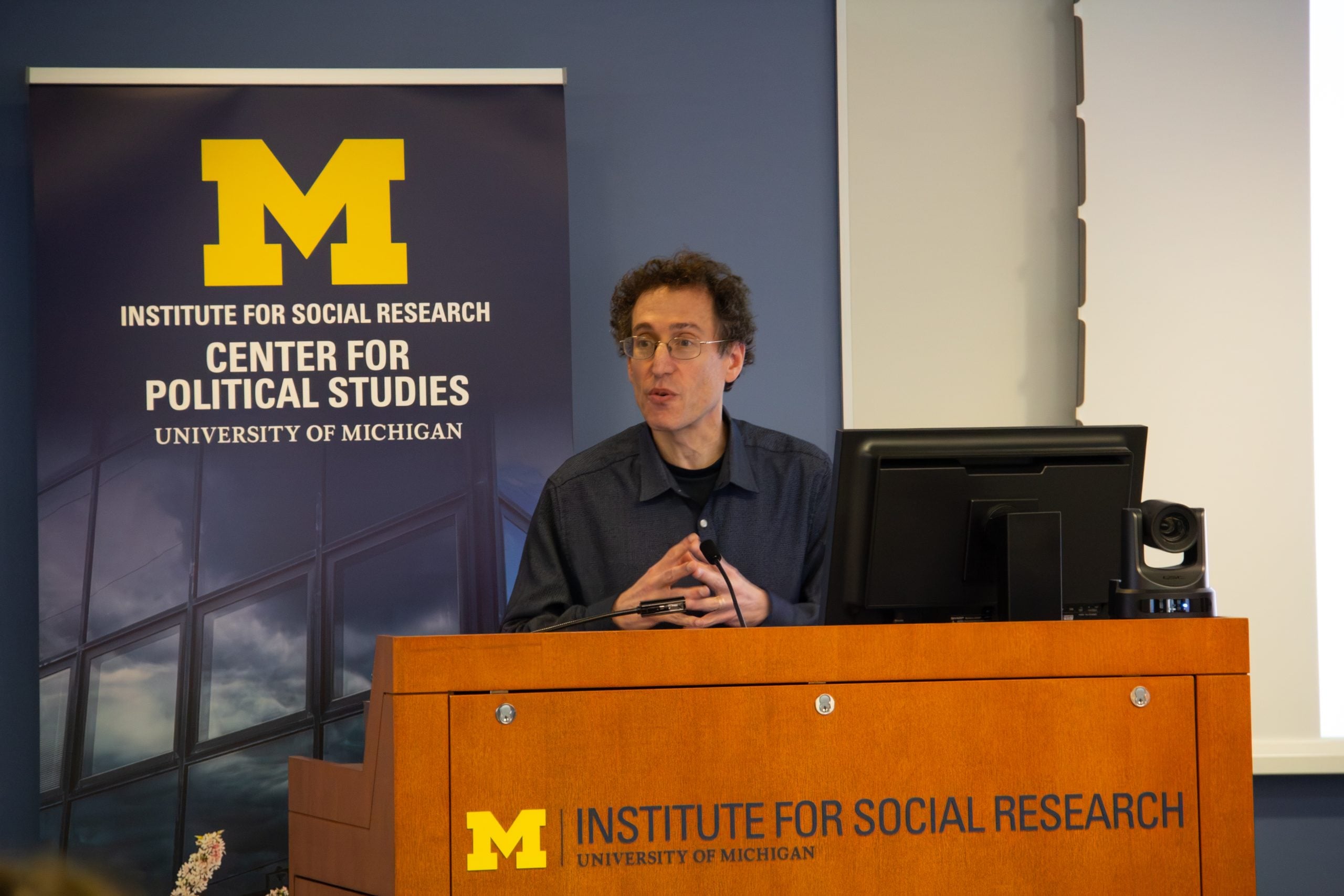
James Druckman presented the Center for Political Studies 2026 Miller-Converse Lecture
At the University of Michigan’s most distinguished lecture series on American electoral politics, political scientist James N. Druckman presented a striking feature of US partisanship in the 21st century: Americans are more polarized in their trust in scientists than in virtually any other societal institution.
During the COVID-19 pandemic, that polarization generated massive discoordination between states, with severe consequences for public health. Why did the U.S., identified as the country best prepared for a global pandemic prior to COVID-19, fare so poorly?
“The intersection of scientific trust and partisan politics likely exacerbated the poor response and has led to a perilous contemporary climate when it comes to science,” said Druckman, whose research points to a way forward.
The Miller-Converse Lecture Series, the University of Michigan’s preeminent lecture on American electoral politics, honors the legacies of Warren Miller, the founder of the Center for Political Studies (CPS), and Philip Converse, former director of both CPS and the Institute for Social Research (ISR)— figures whose work on political behavior, public opinion, and institutional innovation shaped the modern study of democracy. Druckman, a professor of political science at the University of Rochester, was introduced by CPS interim director Michael Traugott, who traced Miller and Converse’s lasting imprint on the field and welcomed an audience that included many of Druckman’s own mentors and collaborators.
A Stable Foundation of Trust
Drawing on more than 50 years of data from the General Social Survey, Druckman showed that trust in scientists has remained relatively high and stable over time. Demographically, marginalized groups tend to trust the scientific community less than their counterparts: Women trust scientists less than men. Black Americans trust scientists less than white Americans. Rural residents trust less than urban ones. The religious trust less than the secular. The less educated trust less than the more educated. The working class trusts less than the middle and upper classes.
“The remarkable thing here is the stability,” Druckman said. “We think about this partisan divide in trust… but you have this incredible stability in these demographic groups. This is 50 years of very little change.”
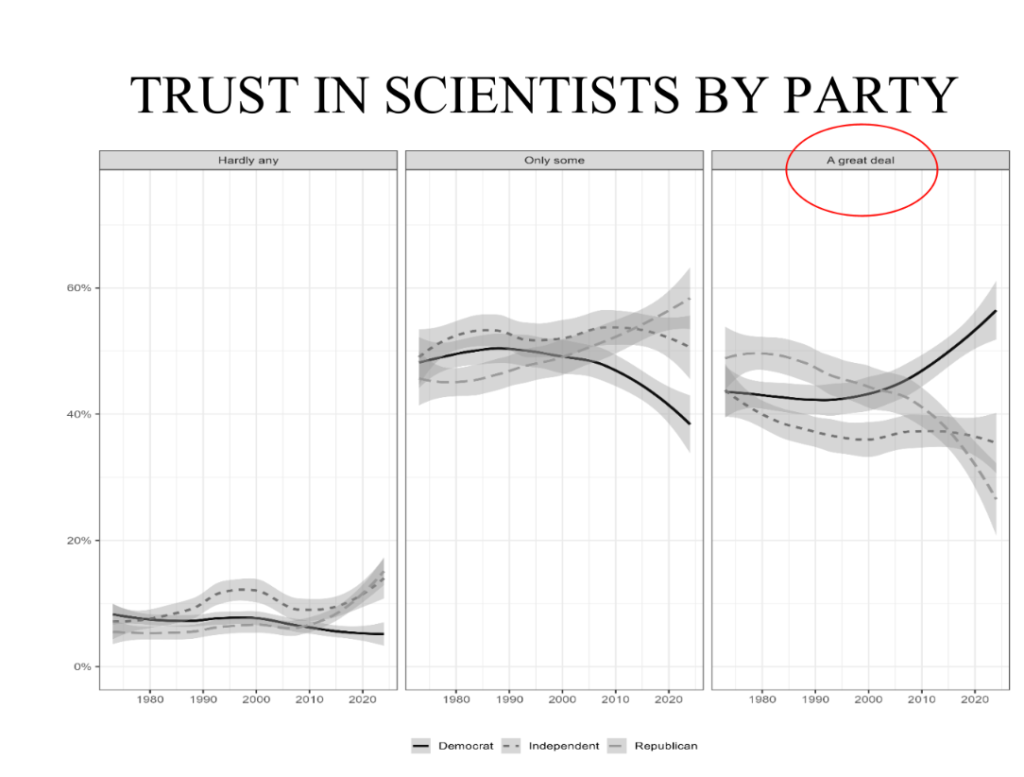
What changed, Druckman explained, was not the trust levels of these groups, but which political party they belonged to. A major partisan realignment during the Civil Rights Era and then in the Reagan era led to a dramatic re-sorting of lower-trusting demographic groups migrating out of the Democratic Party and into the Republican Party. The result was a partisan gap in trust in scientists that barely existed before 2000 but has since become the largest institutional trust divide between the two parties—larger than gaps in confidence in the Supreme Court, organized religion, or the military. Over recent decades, the percentage of Democrats who trust scientists “a great deal” has risen as dramatically as it has faltered among Republicans.
When the Pandemic Hit
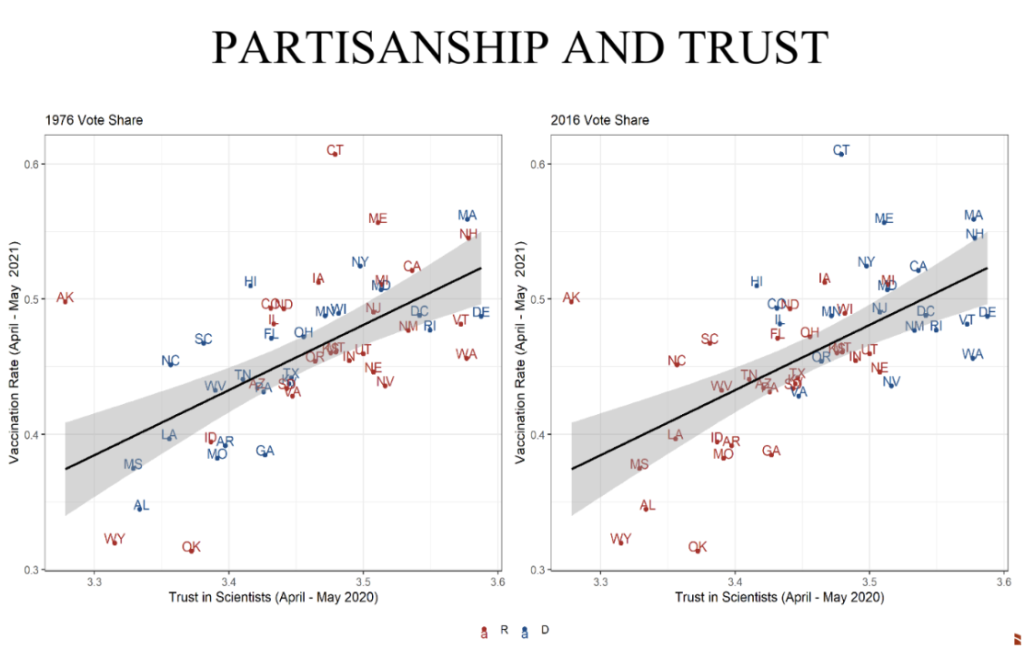
This mattered enormously during the COVID-19 pandemic, Druckman argued, because trust in scientists directly shaped public health behavior and outcomes. Using data from the COVID States Project—a massive, ongoing survey effort that collects representative samples from all 50 states—he demonstrated strong relationships between trust in scientists and COVID-19 vaccination rates, both at the individual and state level. States where residents expressed more trust in scientists had higher vaccination rates– and lower mortality.
This was not a new phenomenon triggered by the pandemic. Because trust levels are so demographically stable, and because the demographics of individual states barely change over time, the geography of scientific trust was essentially locked in place long before COVID-19: Druckman showed that a measure of trust in scientists from 2020 could predict not only COVID outcomes but also state-level car accident deaths from 1994—and even from 1960.
“As COVID approached, in some sense, you could have looked at public health outcomes going back over decades, and you could have forecasted which states were going to do better or worse,” Druckman said. “There’s a relationship going on.”
A pair of graphs vividly illustrated the point. Plotting state-level trust against vaccination rates and coloring the states by their presidential vote, Druckman showed that in 1976, Democratic and Republican states were scattered randomly across the trust-vaccination landscape. By 2016, the sorting was nearly complete: blue states clustered in the high-trust, high-vaccination corner; red states in the low-trust, low-vaccination corner. Had the pandemic struck in 1976, the politics would have looked entirely different—not because trust patterns were different, but because the parties hadn’t yet sorted along those lines.
The Consequences of Discoordination
The real-world fallout of this overlap between partisanship and scientific trust has been severe. Druckman pointed to the fracturing of America’s public health infrastructure: the CDC altered vaccination schedules in 2025, Democratic states formed independent health alliances, and Florida moved to cancel all vaccine mandates. Similar discoordination and inefficiency extends well beyond public health into other domains: Abortion policy, K-12 education, environmental regulation, and election law.
Even outcomes that might seem like wins for the “trusting” side carry costs. Druckman noted that states with higher trust in scientists experienced greater learning loss during the pandemic, likely because they kept schools closed longer. Public health, he reminded the audience, is fundamentally about trade-offs—and a politicized, fragmented system makes those trade-offs harder to navigate wisely.
A Path Forward
Druckman offered an evidence-based path forward centered on diversifying the scientific workforce. Using a conjoint experiment in which respondents chose between scientists with varying demographic profiles, he found that people consistently preferred to follow vaccination advice from scientists who resembled them—matching on race, gender, religiosity, rurality, and class. This effect was especially pronounced among groups historically underrepresented in science, precisely the groups with the lowest baseline trust.
Strikingly, when all demographic matches aligned, their combined effect on trust equaled that of additional years of scientific experience. And over the course of the experiment, respondents who happened to see more demographic matches showed measurably increased trust in scientists by the end—an effect that, when projected to the state level, suggested that increasing the diversity of visible scientists could meaningfully narrow the partisan trust gap.
“If you can increase the diversity of the scientific workforce, there’s some evidence that you can increase the trust in scientists,” Druckman explained, emphasizing that diversity should be understood broadly—encompassing not just race and gender but also rurality, religiosity, and class background.
He acknowledged the challenges: even under the most optimistic scenarios, diversifying the scientific workforce would take decades, and the current political environment has made even using the word “diversity” fraught. But he also stressed that science communication itself could change more quickly. During COVID, he argued, communication was too often driven by a “deficit model”—scientists simply delivering information to the public—when a community-based, bridge-building approach would have been more effective. He pointed to the decisions by Scientific American and Nature to make presidential endorsements in 2020 as well-intentioned, but counterproductive, citing experimental evidence that such endorsements lowered trust in scientists among Republicans.
The Bigger Picture
Druckman closed by situating his findings within a broader landscape of institutional distrust, rising affective polarization, declining feelings of political representation, and a striking recent drop in national happiness that has failed to rebound to pre-pandemic levels.
He also issued a challenge to the discipline – Biden’s COVID task force included no social scientists, he noted, despite the pandemic being fundamentally a social problem. “I don’t put that on the administration,” he said. “It’s just been really hard—social scientists haven’t found a way to make ourselves more present in public policy decisions.”
America’s fractured response to COVID-19 was not simply a product of the moment’s politics. It was the predictable result of long-standing patterns of trust colliding with decades of partisan realignment. The good news: Trust can be built—but only if scientists and institutions are willing to meet distrusting communities where they are, with messengers who look like them and engage in listening.
The Miller-Converse Lecture Series continues to fulfill its mission of illuminating the forces that shape American democracy and public opinion.
This post was written by Tevah Platt, communications manager for the Center for Political Studies.